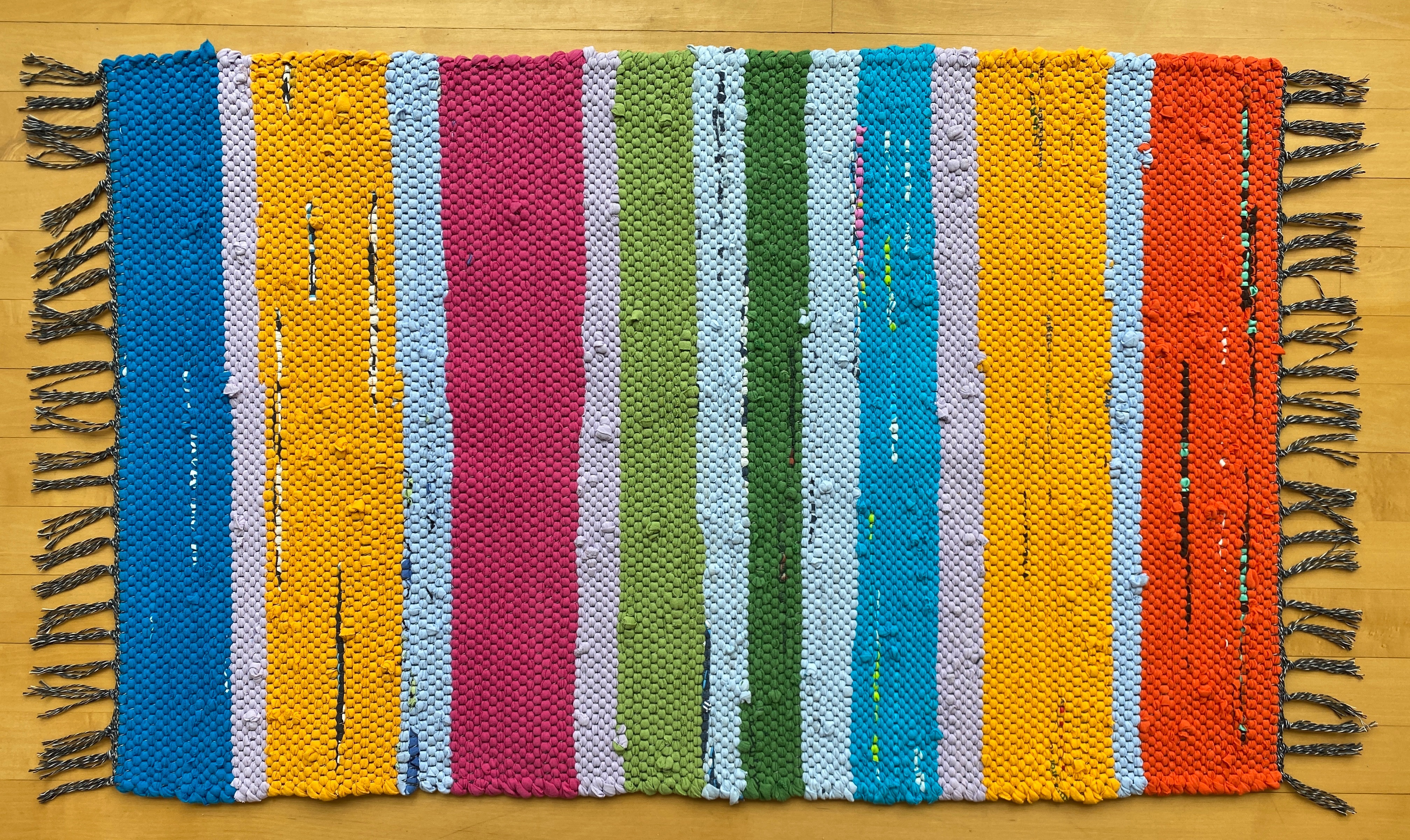
2 ft X 3 ft
T-shirt rags make durable rugs from shirts that are too shabby to go on as clothing. My first t-shirt rug, woven more than 15 years ago, is still in the bathmat rotation for my family of four. T-shirt rags also weave up quickly. Even with an energetic, weighted beat, the doubled rags fill an inch every four or five picks.
Structure
Plain weave
Equipment
2- or 4-shaft loom with a beater that can be weighted, 24” weaving width
8- or 12-dent reed ≥24”
1 rag shuttle; 1 boat shuttle
4 lbs or more lashed to the beater for maximum force
Yarn
Warp: cotton rug warp (1,600 yd/lb)
Weft header: cotton rug warp (1,600 yd/lb), doubled
Weft Rags: worn jersey knit T-shirts cut into about 2.5 lbs of strips: torso cut into 1” wide loops or a spiral, and long 1” wide strips cut around the chest and shoulders. An adult XL T-shirt yields about 0.4 lbs rags. Use double strands of rags – either torso loops knotted into long lengths or paired 1” strips.
Supplies
Sharp fabric scissors, rotary cutter and mat
Sett
Warp: 6 ends per inch
Weft: 4-5 rag picks per inch with firm beat
Dimensions
Width in the reed: 24”
Woven length on the loom: 38”
Approximate finished size after washing: 25” X 36”
Warp shrinkage: 6%
Weft growth: 1%
Materials Considerations
Sort for Uniformity
As a raw material, t-shirts present some challenges. Except for cotton undershirts, which enter wardrobes in packs of 2-6, most household collections of retired t-shirts offer a ragbag of variability. Generally, no two colors are the same. Although sorting by color seems like a natural first move, this pleasant activity must wait until after the shirts are sorted by fabric and fiber.
First by Structure
The first source of variability to grasp is knit structure. Jersey knits, in undershirts and most graphic t-shirts, make a firm rug that holds the original weaving width. Rib knits, in women’s, form-fitting t-shirts and children’s sleepwear make a thick, dimensionally unstable weft. Good rugs can be made from both structures but mixing them in the same rug causes uneven selvedges. After finishing, jersey knit rags might grow 1-2% in the weft direction. Rib knit rags can grow as much as 11% in the weft. (I use growth, the opposite of shrinkage, as a novel concept in handwoven finishing.) Sort the t-shirts first by knit structure.
Second by Fiber
Fiber content can also affect the dimensional behavior of the rags. I throw out/donate all t-shirts that have elastic. Elastic gives the rags their own energy. Springy recovery, ripples, squish, and pliability may be desirable in other applications, but they can make floor coverings hazardous.
Lightweight jersey knit T-shirts made with blends of cotton, rayon, and polyester perform much like cotton jersey knit rags, but they are flimsier to handle, and they collapse in the warp more. The heathered colors can be a little sadder than saturated 100% cotton shirts as well.
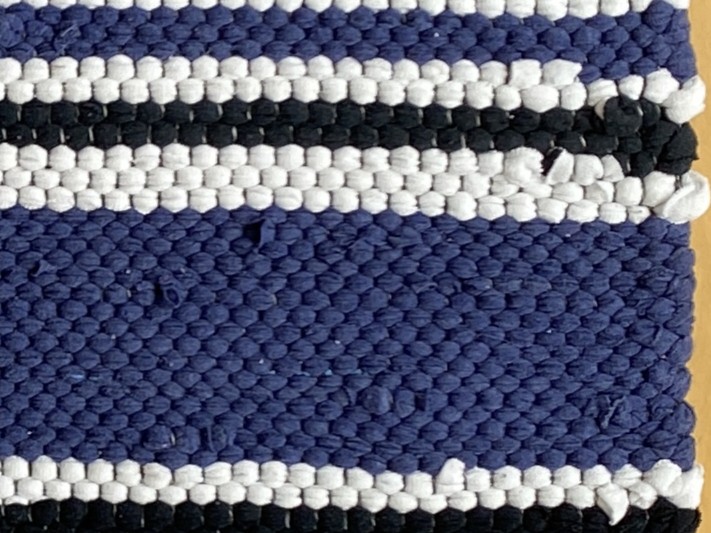
With some planning these differences can be used as design features. The fiber blend rags will hide the warp altogether making solid weft stripes. 100% cotton weft stripes will be broken up by a speckling of warp.
Cutting T-shirts
Preparing the T-shirt rags comes down to balancing the T-shirt waste against the waste of a weaver’s good time. The most easily harvested rags come from the torso of the T-shirt. Making straight cuts across the torsos of several T-shirts, you can cut enough loops for a 2’ X 3’ rug in just under an hour. By contrast, it takes 3 ½ hours to hand cut the same weight of strips out of the leftover tops of T-Shirts even after pre-cutting with a rotary cutter.
Given the extra time investment, why would anyone cut up the tops of T-shirts for rugs?
- Using the top of the T-shirt increases the amount of a unique color available for rug stripes.
- Using the top of the T-shirt keeps another 32-42% of the T-shirt out of the waste stream. For XL and larger shirts the strips from the top consistently represent more than 40% of the whole shirt.
Weaving
Lay in weft at a low angle without any tension. Knit rags have different tensile properties than yarns and woven rags. Because the yarns in knit structures have room to move, they can accommodate deformation in the woven structure without drawing in.
Do fiddle with the selvedges as you lay in the weft. Throw the shuttle, pull a neat turn at the selvedge, using two fingers comb the weft down to the fell at the turn, straighten the rest of the rag onto the diagonal, and then beat.
Crank up the tension on the warp as high as you dare and beat hard. The extra weight called for on the beater will help pack the weft in.
Lay in sticks as you wind rug onto the cloth beam. A big jellyroll of rug with a flexible knit weft can deform at the selvedges. This causes tension problems on the loom and can make for shape problems in the finished rug.
Further Reading
Projects with T-shirt rags
Scorgie, Jean. “Herringbone Rep Totes.” Weaver’s Craft3, March 10, 2016.
Robinette, Amanda. “Perfect Marriage T-Shirt Rug.” Handwoven, September/October 2014.
Stripe layout
Brodén, Märta. Trasmattor Och Andra Mattor, 1955.
Ignell, Tina. Favourite Rag Rugs. Västerås: ICA bokförlag, 2006.
Ingers, Gertrud. Nya Mattor : Trasmattor, Ryor, Rölakan, 1959.
 textileTMI